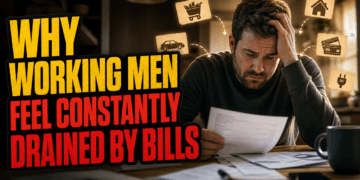


You check your bank balance after a strong month and still feel that small tightening in your chest. On paper, everything looks fine, but the feeling of being behind does not go away, and that is usually the part people cannot explain.
Why This Happens
High earners often assume financial insecurity should disappear once income rises, but money confidence does not always follow income. A bigger paycheck can reduce pressure in one area and quietly raise expectations in another, which is why the feeling can stay stubbornly in place. The real issue is often not the amount coming in, but the mental comparison running in the background every day.
For many people, income growth brings a new level of responsibility, not relief. A larger mortgage, private school tuition, higher taxes, family support, or a more expensive standard of living can absorb the extra room almost immediately. What looked like progress becomes a new baseline, and the nervous system never gets the message that there is enough.
This is why a person can earn well and still live with a constant sense of pressure. They may be paying bills on time, investing regularly, and even saving, yet still feel one step away from trouble. The feeling is real because the brain is not reacting only to math; it is reacting to uncertainty, memory, and the fear of losing what has been built.
There is also a psychological lag that many people never name. Someone who spent years feeling stretched does not automatically become calm when the numbers improve. The body keeps scanning for risk, and that old pattern can make a healthy balance sheet feel fragile.
The Hidden Pattern Behind It
The hidden pattern is often this: income rises, but so does identity pressure. People do not just ask, “Can I afford this?” They also ask, “What kind of life am I supposed to be living now?” That question can quietly drive spending choices that feel justified in the moment and heavy later.
High earners are especially vulnerable to lifestyle inflation because the upgrades are socially invisible at first. A nicer car, more frequent travel, a larger home, or premium services can seem like reasonable rewards for hard work. But over time, each increase in spending becomes part of the new monthly load, and the sense of freedom does not increase as fast as the income did.
Another hidden pattern is the gap between objective security and subjective security. Someone may have a strong emergency fund and still feel unsafe because they are comparing themselves to peers, colleagues, neighbors, or an imagined version of where they should be by now. This is usually where people realize their money is not random, it is patterned.
The pattern often looks like this:
– More income leads to more visible obligations.
– More obligations create less breathing room.
– Less breathing room creates more scanning for risk.
– More scanning makes the person feel poor again, even when they are not.
That loop can be exhausting because it rewards vigilance and punishes satisfaction. The person becomes excellent at detecting what could go wrong, but not as skilled at recognizing what is already working. Over time, the nervous system learns to treat comfort as temporary.
Common Mistakes People Make
One common mistake is assuming the problem is lack of discipline when it is actually a lack of clarity. High earners often have money moving in many directions at once, and without a clear structure, the flow feels chaotic even if the totals are healthy. A budgeting tool can help here, not because it fixes behavior by force, but because it makes the pattern visible.
Another mistake is confusing high income with automatic resilience. Income alone does not protect someone from irregular cash flow, uneven bonus cycles, tax surprises, or a heavy spending culture. When people do not plan for those shifts, they interpret the stress as personal failure instead of predictable friction.
Many people also make the mistake of treating every discomfort as a sign they need to earn more. That can become a reflex. The emotional logic sounds simple: if I feel insecure, I must not have enough. But often the real issue is that the person has not built enough margin between their income and their commitments.
A third mistake is hiding money stress because it feels embarrassing at a higher income level. That silence tends to make the problem worse. When no one names the anxiety, people compensate privately with impulse spending, overwork, or constant checking, which only deepens the feeling of instability.
People also forget that comparison is part of the equation. If everyone around you appears comfortable, successful, and upgraded, your own finances can feel inadequate even when they are solid. In that environment, it is easy to mistake social pressure for financial reality.
Real-Life Patterns and Behaviors
High earners who feel financially insecure often share the same daily behaviors, even if their incomes look very different. They may check their accounts repeatedly, delay looking at investments, or mentally rehearse worst-case scenarios in quiet moments. The behavior does not always look dramatic, but it keeps the body in a state of alert.
They also tend to spend in ways that are emotionally rational, even if they do not look logical later. For example, someone may buy convenience, privacy, or status because those things create a moment of relief. The purchase is not just about the item; it is about escaping pressure for a few minutes.
A lot of insecurity lives in the space between earning and deciding. When decisions are made quickly, without a system, the person feels like money is always slipping through their hands. A simple tracking tool or monthly budget review can reduce that feeling by showing where money actually goes instead of where it was hoped to go.
The behaviors often repeat in subtle ways:
– Avoiding full visibility until the numbers feel “better”
– Overspending after stressful work periods
– Justifying upgrades as necessary maintenance of a hard-earned lifestyle
– Feeling guilty after spending, then trying to “fix” it by saving aggressively
These cycles matter because they create an emotional whiplash. The person swings between pressure and control, and neither state feels restful. That is why many high earners are not really chasing more money as much as they are chasing relief.
There is also a common pattern of over-responsibility. High earners often carry the financial needs of children, parents, partners, or extended family. Even when they are doing well, the margin they feel is being shared before they ever get to enjoy it. That can make safety feel conditional, not stable.
What Actually Helps
What helps most is not a dramatic financial overhaul, but a more accurate picture of the pattern. When people can see fixed costs, variable spending, irregular expenses, and savings flow in one place, the fear usually becomes less vague. This is where calculators and budgeting tools can be useful, because they turn emotional uncertainty into something measurable.
It also helps to separate security from lifestyle. A person can live a calmer life with a smaller set of commitments than their income might suggest. That does not mean giving everything up. It means noticing which expenses actually support well-being and which ones merely protect an image of success.
A calm money system usually has a few features:
– Regular account reviews, not obsessive checking
– A spending structure that matches real habits
– Savings goals that are specific and visible
– Room for irregular costs so surprises do not feel like emergencies
Another helpful shift is understanding that financial insecurity is often a nervous system response, not a character flaw. If someone spent years fearing not enough, they may need repeated evidence of safety before they feel it. That evidence comes from consistency, not from one perfect month.
It can also help to name the emotional trigger behind the spending. For one person it may be fatigue. For another, it may be social comparison, guilt, or the need to reward themselves after pressure. Once the trigger is visible, the person can start responding to the feeling instead of automatically obeying it.
What To Do Next
If this pattern feels familiar, the next step is not to judge it, but to map it. Look at one recent month and ask a simple question: where did money feel tense, and where did it feel easy? That contrast often reveals the real behavior underneath the numbers.
From there, use a basic budgeting tool or income and expense calculator to see whether the insecurity is coming from spending drift, uneven cash flow, or a genuine margin problem. The point is not to make the budget perfect. The point is to make the pattern visible enough that it stops feeling mysterious.
If you are a high earner who still feels behind, start with one calm review instead of a complete financial reboot. A single clear snapshot is often enough to replace vague fear with something more manageable. And once the pattern is named, it becomes much easier to change without forcing yourself into panic or shame.
Related Reading
- Why Do I Always Feel Financially Stressed? The Pattern
- Why Money Arguments Feel More Personal Than Financial
- Why Immediate Bills Make Debt Feel Impossible
Keep Exploring the Pattern
Watch more breakdowns of real-life money behavior on our YouTube channel.
Browse the full Money Behavior Library to explore more patterns like this one.
If you want a clearer view of your monthly patterns, try the Salary Breakdown Calculator, the Subscription Cost Calculator, or the Bill Due Date Planner.
Explore more patterns in the Money Behavior Library — a growing collection of real-life financial patterns explained clearly.
Disclaimer:
This content is for educational and informational purposes only and does not constitute financial advice. Always consult a qualified financial professional before making personal financial decisions.