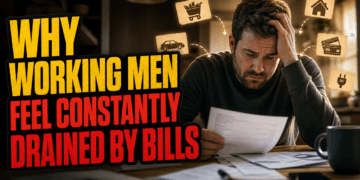


Financial stress often shows up in men long before it is named as “stress.” It looks like irritation after work, trouble sleeping, skipping checkups, drinking a little more, or feeling permanently on edge about bills. The money problem is real, but the health impact is usually quieter and less visible. That is partly because many men are taught to absorb pressure, stay useful, and keep moving. This article looks at the behavioral pattern behind that connection and why money strain so often turns into body strain.
When Money Pressure Becomes a Body Problem
Financial stress is not only about account balances. Once money feels unstable, the nervous system often treats everyday life like a threat: work emails feel heavier, small expenses feel sharper, and sleep becomes less restorative. Over time, that constant alertness can show up physically as fatigue, headaches, muscle tension, stomach trouble, or a general sense of being worn down.
For many men, the shift is easy to miss because the stress is translated into function. Instead of saying “I am overwhelmed,” the pattern becomes “I need to handle it,” “I will push through,” or “I cannot afford to slow down.” That keeps life moving, but it also means the stress has fewer release valves.
The Quiet Habits That Keep Stress Hidden
Men often respond to financial pressure by tightening their behavior rather than naming their experience. They may work longer hours, take on more side income, avoid looking at the full picture, or delay anything that feels like a weak point: a doctor visit, a hard conversation, a budget review, or a debt statement.
Those habits can look responsible from the outside. In practice, they can create a loop where the money problem stays emotionally unresolved even as the calendar gets fuller. The less visible the stress, the easier it is for it to settle into daily routines and become normal.
A useful question is: am I solving the problem, or am I only staying busy around it? That distinction matters because constant motion can be a form of avoidance.
Why Providing Can Turn Into Private Pressure
For many men, money is tied to identity in a practical but heavy way. Paying bills, covering family costs, or keeping a household steady can feel like proof of competence. When income is uneven or debt feels larger than expected, the emotional reaction is not just worry about numbers. It can also feel like a threat to role, pride, and self-respect.
That is one reason financial strain can be hard to discuss. Admitting stress may feel like admitting failure. So the pressure stays internal, and internal pressure tends to show up somewhere else: sleep quality, patience with family, concentration at work, or a shorter fuse in ordinary situations.
This is not about weakness. It is about a very common human pattern: when a problem is linked to identity, people often protect the identity first and address the problem second.
Stress Behaviors That Make Health Worse
Financial stress can push people toward short-term relief choices that seem harmless in the moment but add up over time. A man who feels pinned down by bills may reach for convenience spending, alcohol, extra caffeine, smoking, late-night scrolling, or skipped meals because those choices are available immediately.
The body tends to absorb that pattern. Irregular eating, poor sleep, and more stimulants can make anxiety feel worse, which then makes money stress feel harder to manage. Even if the spending itself is not dramatic, the combined effect can be.
A simple behavioral rule helps here: if a money coping habit also disrupts sleep, appetite, or recovery, it is probably costing more than it appears to in the moment.
The Work-Sleep-Money Loop
One of the most common patterns is the loop between financial pressure and overwork. A man feels behind, so he works more. Working more leaves less time for rest, exercise, family, or planning. The reduced rest makes concentration worse, which can hurt job performance and make money feel even tighter. Then the cycle restarts.
This loop is especially hard because it can look productive. Extra hours create the feeling of effort, and effort feels safer than uncertainty. But health rarely benefits from a schedule that leaves no room for recovery.
Breaking the loop does not always mean working less immediately. It may mean protecting sleep, setting one weekly money check-in, or deciding which tasks truly require more income and which require better organization.
A Practical Way to Spot Financial Stress Early
If you want to catch financial stress before it becomes a health problem, look for changes in behavior rather than waiting for a crisis. Ask three questions:
– Am I sleeping differently than I used to?
– Am I avoiding bills, statements, or appointments because they make me tense?
– Am I using spending, food, alcohol, or work to stay numb or distracted?
If two or more of those are happening regularly, money may be affecting more than your budget. It may be affecting your baseline level of strain.
Another useful check is whether your financial thoughts are mobile. If money worries follow you into dinner, bedtime, and downtime, they are not staying in the “finance” category anymore.
Lower the Pressure Without Pretending the Problem Is Small
The goal is not to minimize the financial issue. The goal is to reduce the amount of hidden stress the issue creates while you work on it. Start with one small structure that makes the problem less vague.
That might mean setting a specific time to review balances, listing the three bills that matter most, or writing down the one expense that keeps triggering panic. Clarity often lowers stress more than motivation does, because vague problems feel bigger than they are.
It also helps to separate the financial decision from the self-judgment. “This account is behind” is a problem statement. “I am failing” is a story. The first can be addressed. The second usually only adds weight.
The Health Cost of Carrying It Alone
Financial stress becomes especially costly when it stays private for too long. Many men wait until the pressure has already affected mood, sleep, relationships, or physical health before they mention it to anyone. By then, the issue is no longer just a budgeting problem. It is a functioning problem.
A calmer approach is to treat money stress like any other strain that deserves attention. That could mean a conversation with a partner, a doctor if symptoms are showing up, or a financial reset that makes the situation more concrete. The point is not to dramatize it. The point is to stop assuming that silence is resilience.
Men’s health is often framed as a medical issue or a lifestyle issue. In practice, it is often also a money-behavior issue. When financial stress stays hidden, it has more room to spread. When it is named early, it becomes easier to manage before it starts shaping the body as much as the budget.
Related Reading
- Why Men Quietly Feel Financially Exhausted by Responsibility
- Why Men Over 40 Quietly Worry About Inflation
- Why Men Quietly Fear Running Out of Money Eventually
Keep Exploring the Pattern
Watch more breakdowns of real-life money behavior on our YouTube channel.
Browse the full Money Behavior Library to explore more patterns like this one.
If you want a clearer view of your monthly patterns, try the Salary Breakdown Calculator, the Subscription Cost Calculator, or the Bill Due Date Planner.
Explore more patterns in the Money Behavior Library — a growing collection of real-life financial patterns explained clearly.
Disclaimer:
This content is for educational and informational purposes only and does not constitute financial advice. Always consult a qualified financial professional before making personal financial decisions.