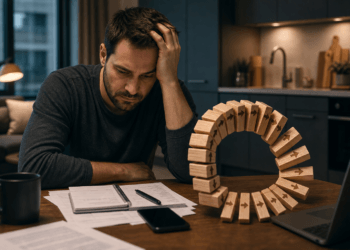


You open your banking app after a long day and already know what you are about to see. A few small purchases, maybe a delivery fee, a refill of something you did not really need, and the quiet feeling that stress somehow turned into spending. That is not random behavior; it is a pattern many people live with before they ever name it.
Why This Happens
Stress changes the way money feels in the body. When your mind is overloaded, spending can become less about the item and more about relief, comfort, or a brief sense of control. A small purchase can feel like a pause button, especially when the rest of the day has felt loud, demanding, or uncertain. That is why people often say, “I know better, but I still did it.”
The important part is that stressed spending rarely begins with a shopping problem. It usually begins with a pressure problem. You may be carrying work tension, family responsibility, health worries, or the invisible exhaustion of keeping everything moving, and your brain reaches for the fastest form of relief it knows. In that moment, the transaction is not just a transaction; it is a mood shift.
This is where the pattern gets easy to miss. You do not need to be having a crisis to spend more when stressed. Even low-level, repeated tension can create a habit loop where discomfort leads to purchase, purchase leads to a brief lift, and the lift teaches your brain to repeat it. Over time, that can make stress and spending feel linked even when you would never describe yourself as impulsive.
People often search for answers like “Why do I shop when anxious?” or “Why do I overspend when I am overwhelmed?” because the behavior feels bigger than logic. And in a way, it is. Money decisions are made in context, not in a vacuum, and stress changes the context before you even notice it.
The Hidden Pattern Behind It
The hidden pattern is usually not “I am bad with money.” It is more often “I am using spending to regulate how I feel.” That may sound small, but it changes everything. A stressed purchase can be a reward, a distraction, a signal of control, or a way to avoid sitting with discomfort for one more minute.
There is also a timing pattern that shows up again and again. People are more likely to spend when they are mentally depleted, not when they are in the middle of a strong, clear thought. This is why stress spending often happens after work, late at night, during a commute, or right after an emotionally draining conversation. The decision is happening when your self-control is already low.
Another layer is that stress narrows your view of time. Instead of asking, “What will this do to my budget this month?” your brain asks, “What will help right now?” That shift makes immediate relief feel more valuable than long-term stability. In that sense, the purchase is solving the wrong problem very efficiently.
This is usually where people realize their money isn’t random; it’s patterned. Once you see the pattern, you can start noticing the repeated sequence:
– pressure builds
– self-control drops
– spending feels soothing
– guilt follows later
That sequence matters because it shows the behavior is not happening out of nowhere. It is attached to a state, a moment, and a need that has not been named yet.
The hidden pattern also explains why willpower alone rarely fixes it. If the real issue is emotional overload, then telling yourself to “just stop spending” is like telling a tired body to run faster. A better question is not “Why am I weak?” but “What feeling is this purchase trying to change?”
Common Mistakes People Make
One common mistake is treating every stressed purchase like a moral failure. That usually creates shame, and shame often leads to more stress, which can lead to more spending. The cycle becomes self-protecting because now the money problem and the emotional problem are feeding each other.
Another mistake is assuming the answer is always stricter budgeting. Budgeting can help, but if the emotional trigger stays untouched, the behavior often leaks through in another form. People might stop buying one category and start spending in another, or they may become more secretive about the purchases. The pattern changes shape, but it does not disappear.
A third mistake is waiting until the stress is gone before looking at the money pattern. For many adults, stress is not a rare event; it is part of ordinary life. Work deadlines, caregiving, household friction, and financial pressure all create background tension, so the real goal is not a stress-free life. It is learning what your stress looks like before it starts steering your spending.
Some people also confuse comfort with care. A takeout order, a new item, or a small upgrade may feel like self-care in the moment, but if it happens every time life feels heavy, it can stop being supportive and start becoming automatic. The difference is not whether the spending feels good. The difference is whether it actually helps you recover.
There is also the mistake of only looking at the size of the purchase. Stress spending is not always expensive in the obvious way. Repeated small purchases, subscriptions, convenience fees, and “just this once” buys can quietly add up, especially when they happen during the same emotional state. A budgeting tool or spending tracker can make this visible, but only if you are willing to look at the timing, not just the total.
Real-Life Patterns and Behaviors
Stress spending tends to show up in ordinary moments, which is why it is easy to dismiss. Someone has a difficult meeting and buys lunch instead of bringing it from home. Someone feels drained after caring for everyone else and orders items that promise a fresh start. Someone is worried about money and responds by buying something that creates a brief sense of normalcy. The behavior makes sense emotionally even when it does not make sense financially.
It often follows a very specific emotional sequence. First there is friction, then mental fatigue, then a small thought like, “I deserve this,” and then the purchase. Later comes the quieter feeling: “Why did I do that again?” That second part matters because the regret is often what makes the pattern stick in memory, even though the original stress was the real trigger.
These patterns are especially common in the middle years of life, when responsibilities are layered. You may be balancing work performance, family needs, aging parents, health concerns, and your own financial goals all at once. When people say they feel like they are “always spending on something,” what they often mean is that life keeps generating pressure points.
Another common behavior is what could be called emotional justifying. The purchase is not framed as a splurge; it is framed as necessary, deserved, practical, or temporary. That language is useful because it reveals the inner negotiation happening before the money leaves your account. You are not simply buying; you are persuading yourself.
A few repeated patterns often show up:
– stress at night leads to online spending
– conflict leads to comfort purchases
– exhaustion leads to convenience spending
– money worry leads to avoidance, then catch-up spending
Once you see those links, you can stop treating each purchase as isolated. The behavior begins to look like a routine the nervous system has built for itself.
What Actually Helps
What actually helps is not perfect discipline. It is making the pattern easier to see while the stress is still happening. That starts with noticing the moment before the purchase, not just the purchase itself. If you can catch the feeling first, you have more room to choose differently.
A soft, practical tool can help here. A spending tracker, a budgeting app, or even a simple notes app can reveal when your purchases cluster around stress, fatigue, or certain times of day. Sometimes a basic calculator is enough to show the total cost of recurring small decisions, which is often more eye-opening than a dramatic budget overhaul. The point is not surveillance; it is awareness.
It also helps to separate relief from spending. If money is being used as emotional relief, then the real question becomes: what else creates a brief reset? A walk, a quiet room, a delay, a call, a snack, a shower, a different routine after work. These are not glamorous fixes, but they interrupt the automatic link between tension and purchase.
This is where many people discover that their money behavior is responding to depletion, not desire. They are not chasing luxury. They are chasing a moment where nothing is needed from them. That realization can be sobering, but it is also relieving, because it makes the behavior understandable instead of shameful.
What helps most is building a pause around the pattern. Not a punishment. A pause. That can mean waiting ten minutes before checking out, moving saved payment information out of one-click convenience, or creating one low-friction alternative for the time of day when you are most vulnerable. When the pattern is predictable, the interruption can be simple.
What To Do Next
The next step is to map your own version of the pattern without judging it. Look at the last few times you spent more when stressed and ask what was happening right before the purchase. Was it fatigue, conflict, loneliness, boredom, fear, or too many decisions in a row? The goal is to name the state, because once the state is named, the spending stops looking mysterious.
If you want something concrete, use a spending tracker or budgeting tool for one week and note the emotion attached to each nonessential purchase. If that feels too detailed, even a basic calculator can help you total the cost of stress-driven buys from the past month. Many people are surprised not by one huge mistake, but by the pattern hidden in the smaller ones.
Then choose one tiny interruption that fits real life. Maybe it is deleting a shopping app for the evening. Maybe it is moving delivery apps off the first screen of your phone. Maybe it is giving yourself a no-cost reset before you decide. The point is not to eliminate comfort; it is to stop letting stress make the decision for you.
If you are ready, start with the numbers, but stay curious about the feeling behind them. That is where the real work begins, and it is usually where the pressure starts to loosen. A calm look at your spending pattern can tell you more than another round of self-blame ever will.
Related Reading
- Why Do I Always Feel Financially Stressed? The Pattern
- Why Am I Broke Even With a Job? The Real Pattern
Keep Exploring the Pattern
Watch more breakdowns of real-life money behavior on our YouTube channel.
If you want a clearer view of your monthly patterns, try the Salary Breakdown Calculator, the Subscription Cost Calculator, or the Bill Due Date Planner.
Disclaimer:
This content is for educational and informational purposes only and does not constitute financial advice. Always consult a qualified financial professional before making personal financial decisions.