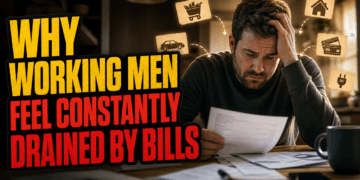


It usually shows up in a small moment: a hospital bill left on the table, a quiet comment about retirement, or a grown child offering help that feels too familiar. For many men, the fear of becoming a burden is not really about one event. It is the feeling that the money story is getting harder to control.
Why This Happens
For a lot of men over 50, the fear of becoming a burden is tied to money long before it becomes tied to health or aging. The concern often starts when income feels less predictable, savings feel thinner than expected, or responsibilities are still hanging around long after they were supposed to end. Even if no one says it out loud, the mind begins doing a quiet calculation: what if I need help, what if I cannot keep up, what if my family has to carry me?
This is not just worry in the abstract. It is a financial identity problem. Many men were taught to measure their value through steadiness, provision, and self-reliance, so any sign of dependence can feel bigger than the dollar amount itself. The fear is rarely only about needing money; it is about what needing money seems to mean.
That is why this pattern often appears in everyday life before it appears in any major crisis. A man may delay a doctor visit because he does not want the bill. He may avoid talking about retirement because he does not want to hear bad news. He may keep working longer than he wants to because stepping back feels like stepping into vulnerability. Each choice may look practical on the surface, but underneath it is often the same question: how do I avoid becoming someone others have to manage?
This is where the emotional search behind the topic matters. People do not usually type, “how do I not feel like a burden” unless they are already carrying shame, pressure, or uncertainty. The money is real, but the meaning attached to it is what makes the fear sticky. Once that meaning takes hold, every decision can start to feel personal.
In daily life, the pattern often sounds like this:
– “I should be able to handle this myself.”
– “I do not want my kids worrying about me.”
– “I cannot afford to need help.”
– “If I slow down now, everything gets harder.”
Those are not just money statements. They are self-protection statements. And when they repeat long enough, they shape behavior in ways that can be expensive, isolating, and hard to reverse.
The Hidden Pattern Behind It
The hidden pattern is that fear of burden often pushes men into a strange mix of overcontrol and avoidance. They may want to know every number, every bill, every risk, yet avoid the one conversation that would make those numbers make sense. They may keep a close eye on spending while refusing to look closely at what retirement, housing, healthcare, or long-term support may actually cost. Control feels safer than uncertainty, even when control is incomplete.
This is one reason the issue can stay hidden for years. From the outside, a man may seem disciplined, private, or simply “careful with money.” But the behavior underneath is often driven by protecting dignity. He may underreport his worries, overestimate how long he can keep pushing, or minimize the possibility that he will ever need assistance. The pattern is not laziness or denial alone. It is often a refusal to let dependence become part of the story.
The trouble is that money does not respond well to silence. If someone avoids planning because planning makes dependence feel real, the financial picture usually gets less flexible over time. Health costs rise. Income changes. Debt lingers. Home maintenance gets more expensive. The longer the fear stays unspoken, the more likely it is to shape decisions from the background.
This is usually where people realize their money is not random. It is patterned. The same fear can create the same response over and over:
– worry leads to delay,
– delay leads to less information,
– less information leads to worse decisions,
– worse decisions deepen the fear.
That loop is exhausting because it feels like a personal failure when it is actually a behavioral cycle. Once you can see the cycle, the conversation changes. The question is no longer “What is wrong with me?” It becomes “What is this fear trying to protect?”
For many men, the answer is simple and painful: it is protecting pride, role, and identity. The fear of burden is often the fear of being seen as less useful, less capable, or less in control. That is why financial stress can feel so much larger than the spreadsheet itself. The spreadsheet is only showing the numbers. The mind is showing the loss of status, autonomy, and certainty.
Common Mistakes People Make
One common mistake is treating the fear like a logic problem only. Men may try to “think their way out” of the discomfort by reading more, calculating more, or waiting until the numbers feel perfect. But perfection is rarely the real issue. More often, the problem is that the money conversation is carrying emotional weight, and no amount of simple arithmetic can remove that weight on its own.
Another mistake is assuming help automatically equals failure. That belief can make people reject useful tools, family conversations, or professional guidance because all of those can feel like admissions of weakness. In reality, the refusal to seek help often costs more than the help would have. Delayed planning, missed benefits, and ignored insurance details can become expensive forms of pride.
A third mistake is comparing current life to an older idea of adulthood. Many men grew up with a model that said a responsible adult should already have things settled by now. If life did not follow that script, shame sneaks in. That shame can lead to secrecy, and secrecy makes it harder to adjust. The result is that the person feels behind, even if the real issue is simply that the old script no longer matches modern costs.
A fourth mistake is believing the burden fear only matters if there is a major problem. In practice, the daily version of this fear shows up in small acts of avoidance and overextension. People put off estate planning because it feels too final. They avoid making a budget because the budget might confirm what they already suspect. They keep saying yes to expenses or obligations because saying no feels selfish. None of that looks dramatic, but together it creates pressure that is hard to escape.
A final mistake is confusing self-sacrifice with strength. Some men wear constant sacrifice like proof that they are still valuable. They do not want to ask for help, and they do not want to be seen resting, slowing down, or needing support. Over time, though, this can drain savings, damage health, and increase dependence in the exact way they were trying to avoid.
Real-Life Patterns and Behaviors
You can often see this pattern in how men talk about specific expenses. Medical care becomes a delay point. Home repairs get postponed. A will or beneficiary update gets avoided because it feels too close to a final reckoning. Even everyday money choices can become loaded when they are connected to the fear of leaving a mess behind.
The behavior usually falls into one of a few patterns. Some men become extremely cautious and overplan small details while ignoring bigger risks. Others act like nothing is wrong and hope momentum will carry them forward. A third group quietly keeps working, spending, or helping others at a pace that is no longer sustainable because stopping feels too much like becoming obsolete.
The emotional pattern often looks like this:
– They want to stay independent.
– They fear being judged for needing help.
– They delay money conversations.
– They feel more stressed when the issue grows.
That sequence can happen whether someone is wealthy, middle income, or struggling. The scale changes, but the behavior is similar. The fear is not always about running out of money. Sometimes it is about running out of options in front of people who matter.
This is also why a lot of men become harder on themselves as they get older. They may frame every setback as proof they should have done better earlier. Instead of seeing the reality of changing costs, shifting markets, health issues, and family responsibilities, they turn the lens inward. That makes the fear heavier because now the money problem and the identity problem are feeding each other.
A man might say he does not want to be a burden, but what he often means is that he does not want to be dependent, vulnerable, or disappointing. Those are different words, but they live close together in real life. When that is the true issue, the solution is not simply “spend less” or “save more.” It is learning how to face the emotional story around money without letting it run the whole household.
This is where tools can be surprisingly useful. A retirement calculator can make vague fear more concrete. A budgeting tool can show whether the pressure is coming from spending, debt, or uneven income. A simple spending tracker can reveal whether the anxiety is based on facts or on a generalized sense of not being enough. The point is not to replace judgment with software. The point is to stop guessing in the dark.
What Actually Helps
What helps most is not a dramatic financial overhaul. It is reducing the emotional charge around the numbers so the numbers can finally be seen clearly. When the fear of burden is strong, people often need a process that feels private, respectful, and manageable. If the first step feels too big, the system will usually resist it.
One helpful shift is to separate dignity from secrecy. A man can still value independence while also acknowledging that planning is not the same as dependence. Writing down expenses, checking savings, or estimating healthcare costs does not make anyone weak. It makes the unknown smaller. That matters because vague fear grows in empty space.
Another helpful shift is to name the real concern more directly. Instead of asking, “How do I stop feeling like a burden?” the question can become, “What specific situation am I afraid of?” Is it paying for care, missing work, needing help at home, or leaving debt behind? The more precise the fear, the more realistic the response. General dread is hard to solve. Specific pressure can be managed.
Support also works better when it is framed as planning rather than rescue. Many men respond better to language like preparation, organization, protection, and clarity. Those words fit the identity they are trying to preserve. A budgeting review, insurance checkup, or estate document update can feel less threatening when it is understood as taking responsibility rather than admitting defeat.
This is often where people realize their money is not random. It is patterned, and patterns can be interrupted. Small steps matter more than perfect ones:
– review one account,
– estimate one monthly cost,
– update one document,
– ask one trusted person one honest question.
Each action gives the mind evidence that the situation is being handled. That matters because the fear of burden is partly a fear of helplessness. The more visible the plan becomes, the less room the fear has to invent worst-case scenarios.
What To Do Next
Start with the part that feels most emotionally loaded, not the part that looks most important on paper. For some men, that is retirement income. For others, it is medical costs, debt, or the fear of relying on adult children. The first move is usually to identify the one question that keeps returning when the house is quiet and the numbers are in front of you.
If you want a practical next step, use a simple calculator or budgeting tool to turn that question into something visible. A retirement estimate, spending tracker, or healthcare-cost calculator can help separate fact from fear. Even twenty minutes of honest review can reveal whether the problem is a gap in savings, a gap in planning, or a gap between what you feel and what is actually true.
Then keep the process small. You do not need a perfect financial reset to make progress. You need a clearer map. Once the map is clearer, conversations with family, a planner, or a trusted advisor become easier because they are based on numbers instead of dread. That is usually the turning point.
If this pattern feels familiar, do not rush past it. The fear of becoming a burden is often a signal that your money life needs more structure, not more self-criticism. A calculator, a simple tracking tool, or one calm review can be enough to begin. The next step is not to prove you are fine. It is to see what is actually there and make a plan from that place.
Related Reading
- Why Men Over 50 Quietly Fear Retirement
- Why Men Over 50 Feel Retirement Is Slipping Away
- Why Men Over 40 Stop Feeling Financially Secure
Keep Exploring the Pattern
Watch more breakdowns of real-life money behavior on our YouTube channel.
Browse the full Money Behavior Library to explore more patterns like this one.
If you want a clearer view of your monthly patterns, try the Salary Breakdown Calculator, the Subscription Cost Calculator, or the Bill Due Date Planner.
Explore more patterns in the Money Behavior Library — a growing collection of real-life financial patterns explained clearly.
Disclaimer:
This content is for educational and informational purposes only and does not constitute financial advice. Always consult a qualified financial professional before making personal financial decisions.